
from$1,867Best seller
Holi & Festival Cultural Tour
Celebrate the festival of colours across the living heritage cities of the Kathmandu Valley, with temples, palaces and local feasts.
- Duration
- 6 days
- Best time
- March, on the day of Falgun Purnima
- From
- $497
- Play Holi with local families
- UNESCO Durbar Squares tour
- Boudhanath & Pashupatinath temples
All treks
- Everest Base Camp16 days
- Annapurna Circuit14 days
- Manaslu Circuit15 days
- Upper Mustang20 days
- Langtang Valley10 days
- Kanchenjunga Trek
- Dolpo Region Trek
- Makalu Trek
Classic Everest Base Camp Trek
Follow the legendary trail through Sherpa villages, glacial moraines and Buddhist monasteries to the foot of the world's highest mountain.
- Duration
- 16 days
- Best time
- Mar to May, Sep to Nov
- From
- $1,867
- Stand at Everest Base Camp (5,364 m)
- Sunrise from Kala Patthar viewpoint
- Namche Bazaar & Tengboche Monastery
All expeditions
- Island Peak Climbing6,189 m
- Cho-Oyu Expedition8,188 m
- Mt Meru Climb
- Himchuli Peak6,441 m
- Chulu West Expedition
Island Peak Climbing
An ideal introduction to Himalayan mountaineering - combine the Everest trail with a guided ascent of Imja Tse (Island Peak).
- Duration
- 20 days
- Best time
- Apr to May, Oct to Nov
- From
- $2,697
- Summit Island Peak (6,189 m)
- Full climbing & rope training
- Everest Base Camp acclimatisation
All destinations
All destinationsUpper Mustang - A Lost Tibetan Kingdom
Journey into the walled city of Lo Manthang, a preserved fragment of ancient Tibet with ochre cliffs, cave monasteries and living Buddhist tradition.
- Duration
- 20 days
- Best time
- Mar to Nov
- From
- $2,387
- Walled capital of Lo Manthang
- Ancient cave monasteries & gompas
- Trans-Himalayan desert scenery
Everest Base Camp Luxury Trek, with Helicopter Return
- Duration
- 12 days, 8 of them on the trail
- Grade
- Strenuous, 4 of 5. The walking is not luxurious
- Max altitude
- 5,545 m (18,190 ft) at Kala Patthar
- Start and end
- Kathmandu to Kathmandu, out by helicopter
- On the trail
- 5 to 7 hours a day, and one day of 7 to 8
- Best season
- Mar to May, and Sep to Nov
- Accommodation
- Four-star in Kathmandu, the best lodges in the Khumbu
- Meals
- All of them, and a better standard of them
- Group size
- Up to 8, and it runs from 1
- Getting there
- Fly to Lukla, helicopter out from Gorak Shep
Overview
The same walk to Base Camp, in the best lodges on the trail, and a helicopter off Kala Patthar instead of four days walking back the way you came.
What you are actually buying
Two separate things, and it is worth separating them. One is comfort: four-star hotels in Kathmandu, and the best lodges in the Khumbu at Phakding, Namche and Dingboche, which means a heated room, a private bathroom, a duvet and food cooked to a standard the ordinary teahouses do not attempt. The other is time: the helicopter off Gorak Shep on day 11 removes four walking days, which is why this trek is twelve days rather than sixteen. Most people booking it are buying the second and being pleased about the first.
What it does not change
The walk up. Days 3 to 10 are the same trail, the same altitudes and the same hours as the classic trek, and there is no version of this in which the walking is easy. You still climb from 2,610 m to 5,545 m on your own legs, you still sleep at 5,164 m at Gorak Shep in a basic lodge, and you can still be turned back by altitude. Above Dingboche there are no luxury lodges because nobody has built any, and the two nights at Lobuche and Gorak Shep are exactly the nights the classic trekkers have.
Why the acclimatisation days survive the shortening
This is the thing to check on any twelve-day Everest itinerary. Ours cuts four days off the walk out, which is entirely below 3,500 m and does nothing to your acclimatisation. Both rest days, at Namche on day 5 and Dingboche on day 8, are still there. Twelve-day itineraries that cut the rest days instead exist and are cheaper, and they are a different and worse product wearing the same number.
The trade you are making
Honestly stated: you lose the walk down. Coming off the mountain on foot through Pheriche and Namche with thicker air in your lungs every hour is, for a lot of people, the best part of the trek, and this itinerary swaps it for an hour in a helicopter. If your constraint is time or knees, that is a good trade. If it is neither, the classic sixteen-day trek is the better trip and it is $1,320 cheaper.
Trip highlights
- Stand at Everest Base Camp (5,364 m)
- Sunrise from Kala Patthar, then fly
- The best lodges in the Khumbu, with heated rooms
- Four-star hotels in Kathmandu
The whole trek on one screen
Twelve days, eight of them walking. Days 3 to 10 are identical to the classic sixteen-day trek; day 11 is where the two part company.
| Day | Route | Walking | Altitude |
|---|---|---|---|
| Day 1 | Arrive Kathmandu | — | 1,400 m (4,590 ft) |
| Day 2 | Kathmandu valley sites | — | 1,400 m (4,590 ft) |
| Day 3 | Fly to Lukla, walk to Phakding | 3–4 hrs, 8 km | 2,610 m (8,560 ft) |
| Day 4 | Phakding to Namche Bazaar | 6–7 hrs, 11 km | 3,440 m (11,290 ft) |
| Day 5 | Namche, acclimatisation day | 2–4 hrs | 3,440 m (11,290 ft) |
| Day 6 | Namche to Tengboche | 5–6 hrs, 10 km | 3,820 m (12,530 ft) |
| Day 7 | Tengboche to Dingboche | 5–6 hrs, 11 km | 4,410 m (14,470 ft) |
| Day 8 | Dingboche, acclimatisation day | 4–5 hrs | 4,410 m (14,470 ft) |
| Day 9 | Dingboche to Lobuche | 5–6 hrs, 8 km | 4,910 m (16,110 ft) |
| Day 10 | Lobuche to Base Camp, sleep Gorak Shep | 7–8 hrs, 13 km | 5,364 m (17,600 ft) |
| Day 11 | Kala Patthar at dawn, helicopter to Kathmandu | 2–3 hrs walking, 1 hr flying | 5,545 m (18,190 ft) |
| Day 12 | Fly home | — | — |
- Day 1
- Route
- Arrive Kathmandu
- Walking
- —
- Altitude
- 1,400 m (4,590 ft)
- Day 2
- Route
- Kathmandu valley sites
- Walking
- —
- Altitude
- 1,400 m (4,590 ft)
- Day 3
- Route
- Fly to Lukla, walk to Phakding
- Walking
- 3–4 hrs, 8 km
- Altitude
- 2,610 m (8,560 ft)
- Day 4
- Route
- Phakding to Namche Bazaar
- Walking
- 6–7 hrs, 11 km
- Altitude
- 3,440 m (11,290 ft)
- Day 5
- Route
- Namche, acclimatisation day
- Walking
- 2–4 hrs
- Altitude
- 3,440 m (11,290 ft)
- Day 6
- Route
- Namche to Tengboche
- Walking
- 5–6 hrs, 10 km
- Altitude
- 3,820 m (12,530 ft)
- Day 7
- Route
- Tengboche to Dingboche
- Walking
- 5–6 hrs, 11 km
- Altitude
- 4,410 m (14,470 ft)
- Day 8
- Route
- Dingboche, acclimatisation day
- Walking
- 4–5 hrs
- Altitude
- 4,410 m (14,470 ft)
- Day 9
- Route
- Dingboche to Lobuche
- Walking
- 5–6 hrs, 8 km
- Altitude
- 4,910 m (16,110 ft)
- Day 10
- Route
- Lobuche to Base Camp, sleep Gorak Shep
- Walking
- 7–8 hrs, 13 km
- Altitude
- 5,364 m (17,600 ft)
- Day 11
- Route
- Kala Patthar at dawn, helicopter to Kathmandu
- Walking
- 2–3 hrs walking, 1 hr flying
- Altitude
- 5,545 m (18,190 ft)
- Day 12
- Route
- Fly home
- Walking
- —
- Altitude
- —
How the trek climbs, and how it does not come down
The climb is the classic one, both acclimatisation days included. What is missing is the right-hand side of the chart: instead of four days walking down, day 11 goes from 5,545 m to 1,400 m in an hour.
Dates and prices
| Dates | Season | Places | Price | |
|---|---|---|---|---|
| 10 Mar 2027 to 21 Mar 2027 | Spring 2027 | 4 places left | $3,187 | Reserve |
| 31 Mar 2027 to 11 Apr 2027 | Spring 2027 | 2 places left | $3,187 | Reserve |
| 14 Apr 2027 to 25 Apr 2027 | Spring 2027 | 5 places left | $3,187 | Reserve |
| 5 May 2027 to 16 May 2027 | Spring 2027 | Just opened | $3,087 | Reserve |
| 15 Sep 2027 to 26 Sep 2027 | Autumn 2027 | Just opened | $3,087 | Reserve |
| 6 Oct 2027 to 17 Oct 2027 | Autumn 2027 | 3 places left | $3,187 | Reserve |
| 20 Oct 2027 to 31 Oct 2027 | Autumn 2027 | 6 places left | $3,187 | Reserve |
| 10 Nov 2027 to 21 Nov 2027 | Autumn 2027 | 7 places left | $3,187 | Reserve |
| 8 Mar 2028 to 19 Mar 2028 | Spring 2028 | Just opened | $3,187 | Reserve |
| 5 Apr 2028 to 16 Apr 2028 | Spring 2028 | Just opened | $3,187 | Reserve |
- 10 Mar 2027 to 21 Mar 2027
- Season
- Spring 2027
- Places
- 4 places left
- Price
- $3,187
- 31 Mar 2027 to 11 Apr 2027
- Season
- Spring 2027
- Places
- 2 places left
- Price
- $3,187
- 14 Apr 2027 to 25 Apr 2027
- Season
- Spring 2027
- Places
- 5 places left
- Price
- $3,187
- 5 May 2027 to 16 May 2027
- Season
- Spring 2027
- Places
- Just opened
- Price
- $3,087
- 15 Sep 2027 to 26 Sep 2027
- Season
- Autumn 2027
- Places
- Just opened
- Price
- $3,087
- 6 Oct 2027 to 17 Oct 2027
- Season
- Autumn 2027
- Places
- 3 places left
- Price
- $3,187
- 20 Oct 2027 to 31 Oct 2027
- Season
- Autumn 2027
- Places
- 6 places left
- Price
- $3,187
- 10 Nov 2027 to 21 Nov 2027
- Season
- Autumn 2027
- Places
- 7 places left
- Price
- $3,187
- 8 Mar 2028 to 19 Mar 2028
- Season
- Spring 2028
- Places
- Just opened
- Price
- $3,187
- 5 Apr 2028 to 16 Apr 2028
- Season
- Spring 2028
- Places
- Just opened
- Price
- $3,187
None of these dates work? That is the normal case.
Most people who travel with us go on their own dates rather than one of the departures above, and it costs no more from a party of five. Tell us the month and we will build the trip around your flights: start on a Tuesday, add a rest day, stretch the whole thing by two days so nothing is rushed. A private departure for one person runs whether anybody else books it or not.
Ask for your own datesWhat it costs by party size
A guide and a porter cost the same whether they walk with one of you or eight, so the price per person falls as the party grows. Every one of these runs, including the first.
| Party size | Notes | Per person |
|---|---|---|
| 1 person | your own guide, and the helicopter is not shared | $4,290 |
| 2 to 4 | $3,480 | |
| 5 to 8 | the published price | $3,187 |
| 9 or more | a second guide, and two helicopter lifts | $3,040 |
- 1 person
- Notes
- your own guide, and the helicopter is not shared
- Per person
- $4,290
- 2 to 4
- Notes
- Per person
- $3,480
- 5 to 8
- Notes
- the published price
- Per person
- $3,187
- 9 or more
- Notes
- a second guide, and two helicopter lifts
- Per person
- $3,040
Itinerary
Day by day, with where you sleep and how far you walk.
Met at the airport and driven to a four-star hotel in the quiet end of Thamel. In the evening we go through the trek, check your kit, and weigh your bag, because the Lukla allowance is enforced whatever you paid for the trip.
- Altitude
- 1,400 m (4,590 ft)
- On foot
- —
- Night in
- Four-star hotel, Kathmandu
- Meals
- Dinner
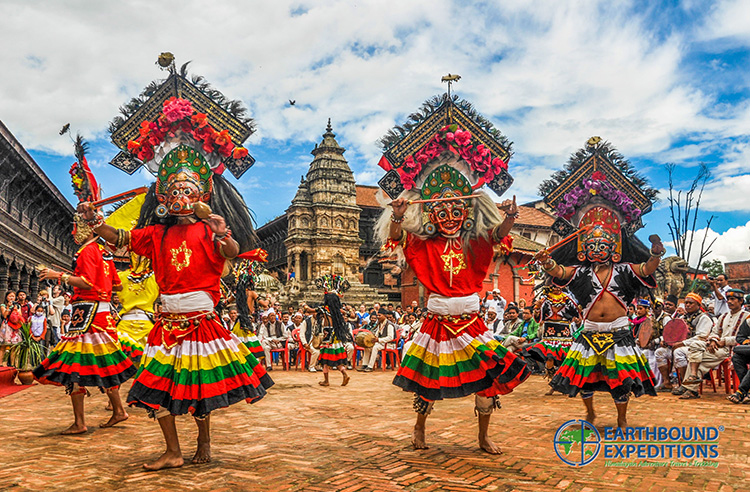
The stupa at Swayambhunath, the river temples at Pashupatinath, the great dome at Boudhanath and the carved squares of Patan, with a guide who can explain the iconography rather than point at it. A private vehicle all day, and an early night.
- Altitude
- 1,400 m (4,590 ft)
- On foot
- —
- Night in
- Four-star hotel, Kathmandu
- Meals
- Breakfast, Lunch, Dinner
The mountain flight in, then a gentle half day downhill beside the Dudh Koshi to Phakding. Easy walking to find your feet, and the first of the mountain lodges: a private room, a hot shower and a heated dining room.
- Altitude
- 2,610 m (8,560 ft)+1,210 m
- On foot
- 8 km, 3–4 hrs
- Night in
- Luxury lodge, Phakding
- Meals
- Breakfast, Lunch, Dinner
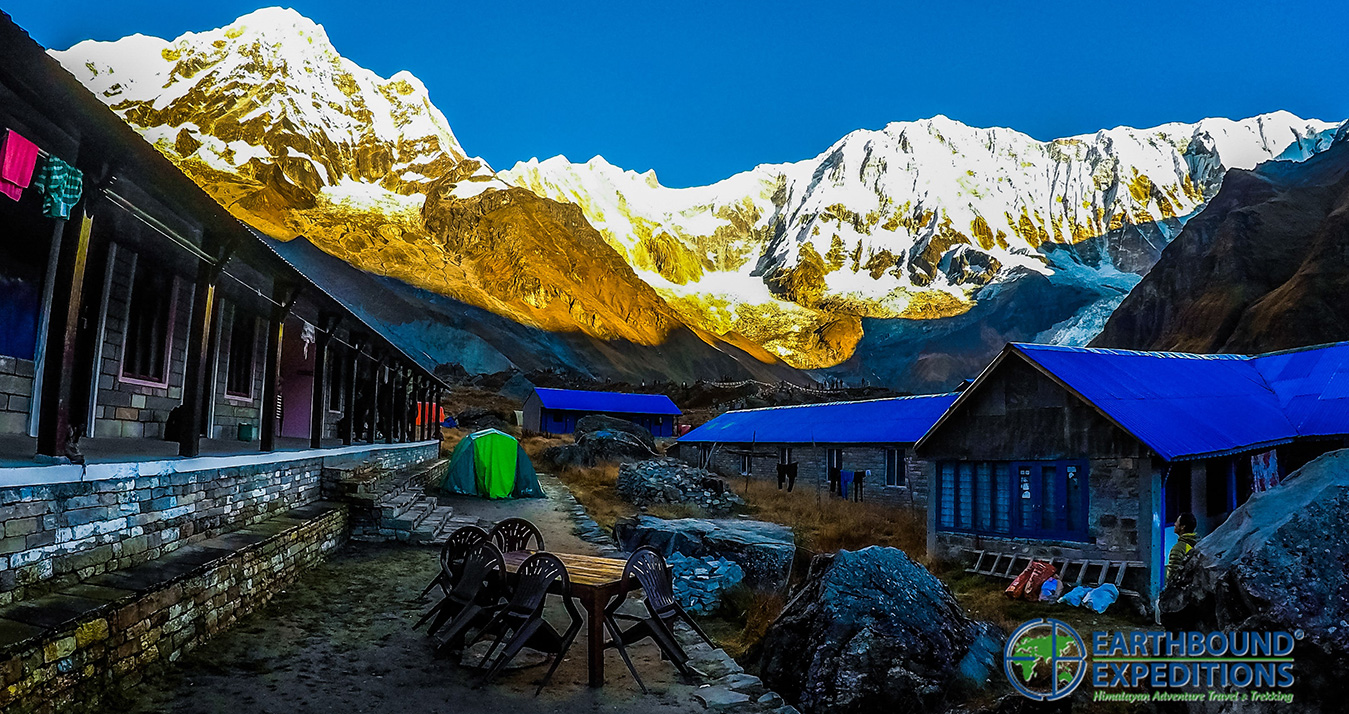
Across the swinging bridges and then the long climb through pine forest to Namche, the Sherpa town wrapped around a hillside. On a clear day you get your first sight of Everest on the way up.
- Altitude
- 3,440 m (11,290 ft)+830 m
- On foot
- 11 km, 6–7 hrs
- Night in
- Luxury lodge, Namche Bazaar
- Meals
- Breakfast, Lunch, Dinner
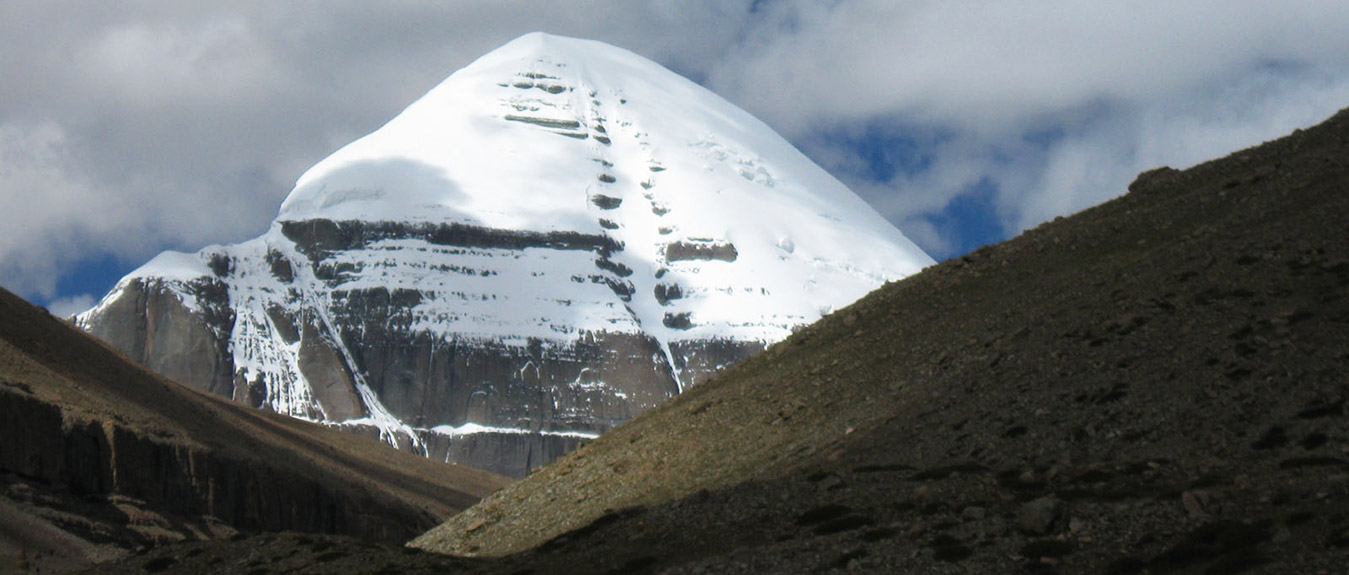
A day to let your body catch up. The climb to the viewpoint above town for Everest, Lhotse and Ama Dablam, then back down to sleep, which is the whole mechanism of acclimatisation. Namche has bakeries, coffee and a hot shower that works.
- Altitude
- 3,440 m (11,290 ft)
- On foot
- Optional 2–4 hrs
- Night in
- Luxury lodge, Namche Bazaar
- Meals
- Breakfast, Lunch, Dinner
An open, scenic day with mountains in view most of the way: down to the river, then a long climb to the monastery at Tengboche on its ridge, with Ama Dablam standing directly behind it. If a service is running you can sit in on it.
- Altitude
- 3,820 m (12,530 ft)+380 m
- On foot
- 10 km, 5–6 hrs
- Night in
- Teahouse, Tengboche
- Meals
- Breakfast, Lunch, Dinner
Through the last of the forest, past Pangboche, and up into open treeless country. The trail follows the Imja river to Dingboche, a huddle of stone-walled fields under the big peaks.
- Altitude
- 4,410 m (14,470 ft)+590 m
- On foot
- 11 km, 5–6 hrs
- Night in
- Luxury lodge, Dingboche
- Meals
- Breakfast, Lunch, Dinner
The second acclimatisation day and an important one. A slow climb up the ridge behind the village earns views of Makalu and Lhotse, two of the highest mountains on earth, and then you come back down to sleep.
- Altitude
- 4,410 m (14,470 ft)
- On foot
- Optional 4–5 hrs
- Night in
- Luxury lodge, Dingboche
- Meals
- Breakfast, Lunch, Dinner
Shorter and higher, up the Khumbu valley. You pass the stone memorials at Thukla, raised for climbers lost on Everest, before reaching Lobuche near the edge of the glacier. From here the comfortable lodges stop and the mountain takes over.
- Altitude
- 4,910 m (16,110 ft)+500 m
- On foot
- 8 km, 5–6 hrs
- Night in
- Teahouse, Lobuche
- Meals
- Breakfast, Lunch, Dinner
The big day. A rocky walk along the glacier to Gorak Shep for lunch, then out across the moraine to Base Camp itself, under the Khumbu icefall. In spring it is a bright village of climbers' tents. We sleep back at Gorak Shep.
- Altitude
- 5,364 m (17,600 ft) at Base Camp+454 m
- On foot
- 13 km, 7–8 hrs
- Night in
- Teahouse, Gorak Shep
- Meals
- Breakfast, Lunch, Dinner
A cold, dark, early start up Kala Patthar for the best view of Everest there is as the sun hits it. Then the part you paid for: instead of four days walking back, a helicopter lifts off Gorak Shep and puts you in Kathmandu in about an hour, flying the whole route you walked. Lunch in a hotel, and a bath.
- Altitude
- 5,545 m (18,190 ft) at Kala Patthar+181 m
- On foot
- 2–3 hrs, then 1 hr flying
- Night in
- Four-star hotel, Kathmandu
- Meals
- Breakfast, Lunch, Dinner
We take you to the airport. As with any Khumbu itinerary, book an international ticket that leaves at least a day after this one, because the helicopter is weather-dependent too.
- Altitude
- —
- On foot
- —
- Night in
- —
- Meals
- Breakfast
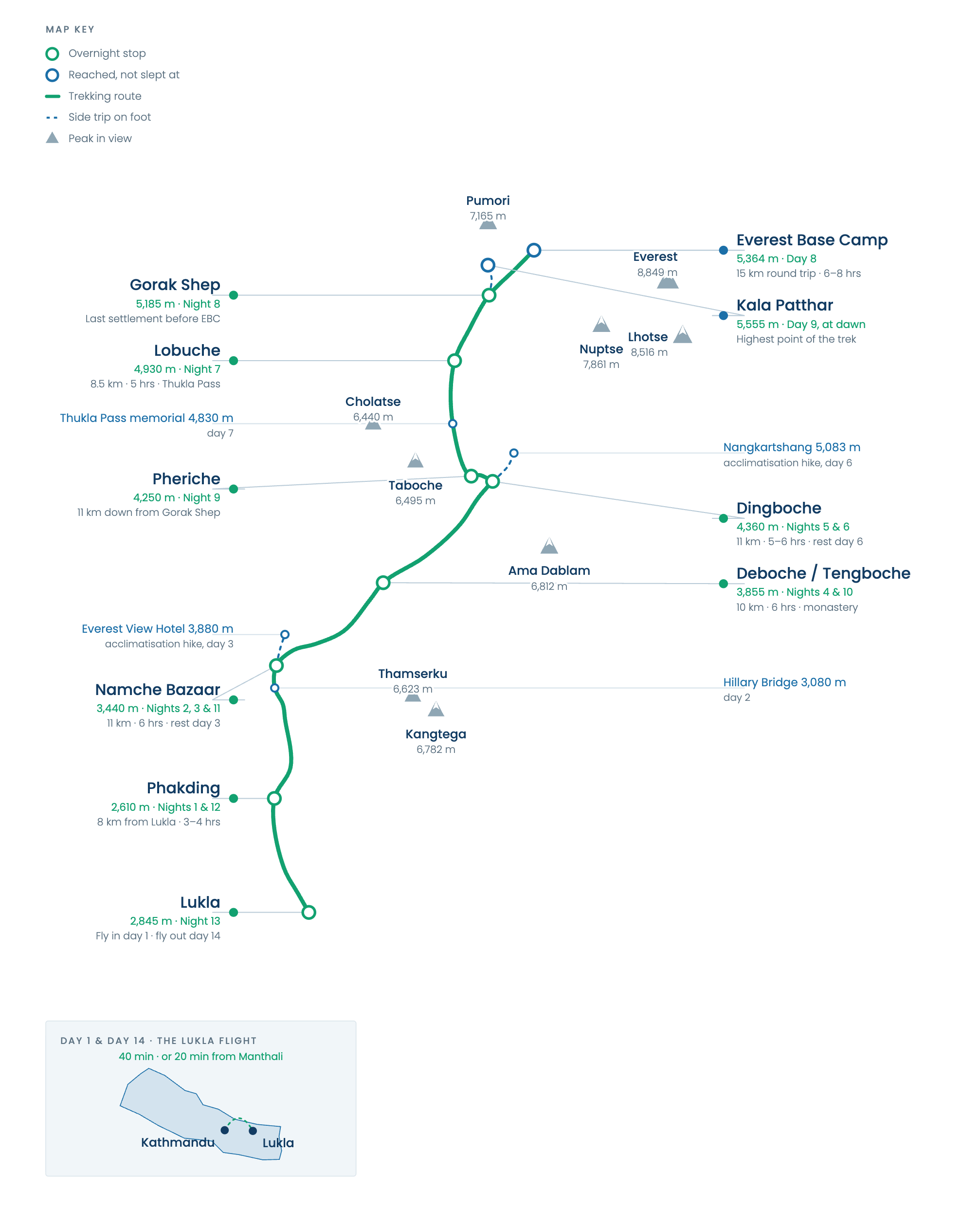
Route map
The trail from start to finish, at a glance.
What's included
Included in Standard
- Airport transfers & ground transport
- Licensed English-speaking guide
- Accommodation throughout the trip
- All permits & national park fees
- Meals as per the itinerary
Not included
- International flights
- Travel & rescue insurance
- Personal trekking gear
- Tips & personal expenses
- Nepal entry visa (on arrival)
What to bring
Two weight limits, and the helicopter's is stricter
The Lukla flight allows 15 kg in total, 10 checked and 5 in hand, and it is weighed. The helicopter out has its own load calculation that is tighter still. One porter per traveller carries up to 20 kg. We provide the duffel, the sleeping bag and the down jacket.
On your head
- Sun hat with a brim, and a warm hat that covers your ears
- Buff or neck gaiter, two of them
- Sunglasses, category 3 or 4. Snow glare at this altitude is serious
- Headtorch and spare batteries
- Sunscreen SPF 50 and lip balm with sun protection
On your body
- Three or four merino or synthetic base layers, no cotton
- Two mid layers, one fleece and one light insulated
- Down jacket. We provide one; bring your own if you sleep cold
- Waterproof shell, jacket and trousers, that packs small
- Two pairs of trekking trousers, one lined
- Underwear for four or five days and wash on the way
Hands and feet
- Liner gloves and insulated outer gloves or mittens
- Broken-in trekking boots with ankle support. Broken in is not optional
- Four pairs of trekking socks, wool
- Camp shoes or trainers for the evenings
- Gaiters, if you are going in winter or early spring
Bags
- Duffel for the porter, 20 kg maximum. We give you one
- Daypack, 30 to 35 litres, with a rain cover
- Dry bags or thick liners. Nothing on a Himalayan trail is waterproof for long
Sleeping
- Sleeping bag rated to −15°C. We provide one
- Silk or cotton liner, for warmth and hygiene
- Earplugs. Teahouse walls are plywood
Health
- Personal first aid: blister plasters, tape, painkillers, rehydration salts
- Diamox, if your doctor agrees, plus anything you take routinely
- Water purification: tablets, a filter, or a SteriPen
- Hand sanitiser and wet wipes
- Throat lozenges. A dry high-altitude cough is close to universal
Papers and money
- Passport valid six months, plus two photocopies
- Four passport photographs for permits
- Travel insurance certificate showing helicopter cover to 6,000 m
- $300 to $500 in small notes. The last cash machine is at Namche Bazaar
What the upgrade means you can leave at home
- A towel. The upgraded lodges provide one, and the two nights that do not are the two you will not wash on
- Laundry for more than four days. Same-day service at Namche and Dingboche is included
- A power bank for the lower half. There are sockets by the bed to Dingboche, though take one anyway for Lobuche and Gorak Shep
- Nothing else. Above Dingboche this is an ordinary Everest trek and the list is the ordinary list
Getting to Lukla, and getting off the mountain
Two flights that can be stopped by weather rather than one, and the second is the one this whole itinerary is built around.
Kathmandu or Ramechhap, depending on the month
Out of the two busiest stretches of the year the flight leaves Kathmandu and takes about 35 minutes. Through most of March to May and late September to November, air traffic control moves Lukla departures to Manthali airport at Ramechhap to take the pressure off Kathmandu. That means a four to five hour drive leaving Kathmandu around two in the morning, then a twenty minute flight. It is the same trek and a considerably worse night. We tell you which one applies to your dates before you book, not after.
Fifteen kilos, and it is weighed
The allowance is 15 kg in total: 10 kg checked and 5 kg of hand baggage. Excess is charged at roughly $1.50 a kilo and it is enforced, because the aircraft is a nineteen-seat Twin Otter or Dornier and the runway is 527 metres long on a slope. Anything you are not taking up the hill is stored free at our office in Kathmandu.
Delays, and what we do about them
Lukla is closed by cloud several times a month in every season. A day lost is common and two is not rare, and this itinerary has no spare day in it, which is a thing to know rather than a thing to discover. If the flight is cancelled for more than three days we change the itinerary to an equally good trek at a lower altitude rather than compress this one, and we do not charge you for the change. There is no spare day in this itinerary, which is a consequence of the twelve-day format rather than an oversight, and it is the single strongest argument for booking your international flight home with two clear days after this trek rather than one.
Book your flight home with a day to spare
Whatever your itinerary says, book an international ticket that leaves at least one clear day after your scheduled return to Kathmandu. It is the cheapest insurance on the whole trip and the thing we most often wish people had done.
The helicopter out, and what it needs
A single-engine machine lifts from Gorak Shep at 5,164 m, which is close to the practical ceiling for a useful load, so it flies early in the morning when the air is coldest and densest and it carries fewer people than the same aircraft would at sea level. It needs a clear window at Gorak Shep and a clear one at Lukla, where it usually refuels. In good weather it is airborne within a couple of hours of the Kala Patthar descent and you are in Kathmandu by lunchtime.
And what happens when it cannot fly
You walk, which is why the guides on this trip carry the classic itinerary in their heads as well as this one. If the weather closes in at Gorak Shep we drop to Pheriche or Namche on foot, where the aircraft can very often get in when it cannot reach 5,164 m, and fly from there. If nothing flies at all, the walk out to Lukla is three days and we cover the additional lodge nights. What we cannot do is give you back the days, which is the honest limit of what a helicopter itinerary can promise.
Weight, again
The same 15 kg allowance applies on the way in, and on the way out the helicopter has its own load calculation that is stricter than the aeroplane's. Nothing you buy in Namche is a problem; a second duffel of things bought in Kathmandu on day 2 and carried up the hill is.
Where you sleep
11 nights, and what each one is
| Where | Nights | Type | Room | Bathroom |
|---|---|---|---|---|
| Kathmandu | 3 | Four-star hotel | Deluxe double or twin | Private, hot water, and a bath |
| Phakding | 1 | Luxury lodge | Twin or double, heated | Private, hot shower |
| Namche Bazaar | 2 | Luxury lodge | Twin or double, heated | Private, hot shower |
| Tengboche | 1 | The best teahouse in the village, which is a good ordinary one | Twin | Private in the room we book |
| Dingboche | 2 | Luxury lodge | Twin or double, heated | Private, hot shower |
| Lobuche | 1 | Ordinary teahouse, because there is nothing else | Twin | Shared |
| Gorak Shep | 1 | Ordinary teahouse, the highest on the route | Twin, basic | Shared, no shower |
- Kathmandu
- Nights
- 3
- Type
- Four-star hotel
- Room
- Deluxe double or twin
- Bathroom
- Private, hot water, and a bath
- Phakding
- Nights
- 1
- Type
- Luxury lodge
- Room
- Twin or double, heated
- Bathroom
- Private, hot shower
- Namche Bazaar
- Nights
- 2
- Type
- Luxury lodge
- Room
- Twin or double, heated
- Bathroom
- Private, hot shower
- Tengboche
- Nights
- 1
- Type
- The best teahouse in the village, which is a good ordinary one
- Room
- Twin
- Bathroom
- Private in the room we book
- Dingboche
- Nights
- 2
- Type
- Luxury lodge
- Room
- Twin or double, heated
- Bathroom
- Private, hot shower
- Lobuche
- Nights
- 1
- Type
- Ordinary teahouse, because there is nothing else
- Room
- Twin
- Bathroom
- Shared
- Gorak Shep
- Nights
- 1
- Type
- Ordinary teahouse, the highest on the route
- Room
- Twin, basic
- Bathroom
- Shared, no shower
Heat, hot water, power and signal
- Heating
- In your room at Phakding, Namche and Dingboche, which is the single biggest difference this trek buys. At Tengboche, Lobuche and Gorak Shep it is one stove in the dining room like everybody else.
- Hot shower
- Included and en suite as far as Dingboche. Nothing above Lobuche, for anybody, at any price.
- Charging
- Free in the upgraded lodges, in your room. $3–5 a device at Lobuche and Gorak Shep.
- Wifi
- Included in the upgraded lodges and genuinely usable. Everest Link cards above them, about $10 for 10 GB, working as far as Gorak Shep, badly.
- Phone signal
- Ncell and NTC cover most of the route to Lobuche. Buy the SIM in Kathmandu.
- Water
- Filtered water provided free in the upgraded lodges. Boiled water $1–4 a litre higher up. We would rather you used either than bought plastic.
- Bedding
- Duvets and proper mattresses to Dingboche. A sleeping bag rated to −15°C for Lobuche and Gorak Shep, which we provide.
- Laundry
- Same-day at Namche and Dingboche, included. It sounds trivial and after five days it is not.
What you eat
| Meal | Time | Usually |
|---|---|---|
| Breakfast | 7:00–7:30 | Porridge, Tibetan bread, eggs, chapati, pancakes, tea or coffee |
| Lunch | 12:00–13:00 | Dal bhat, fried rice, noodles, soup, momo, potatoes in every form |
| Dinner | 18:30–19:30 | Dal bhat, pasta, thukpa, curry and rice, soup to start |
| Tea | on arrival | Black, milk, lemon, ginger, or masala. Included at every stop. |
- Breakfast
- Time
- 7:00–7:30
- Usually
- Porridge, Tibetan bread, eggs, chapati, pancakes, tea or coffee
- Lunch
- Time
- 12:00–13:00
- Usually
- Dal bhat, fried rice, noodles, soup, momo, potatoes in every form
- Dinner
- Time
- 18:30–19:30
- Usually
- Dal bhat, pasta, thukpa, curry and rice, soup to start
- Tea
- Time
- on arrival
- Usually
- Black, milk, lemon, ginger, or masala. Included at every stop.
If you eat differently
| Diet | On this route |
|---|---|
| Vegetarian | Easy the whole way. Dal bhat is vegetarian and it is the best thing on the menu. |
| Vegan | Manageable with notice. Say so when you book so the guide can order ahead. |
| Gluten free | Rice, dal, potatoes and eggs are safe. Bread, noodles and momo are not, and cross-contamination in a teahouse kitchen cannot be ruled out. |
| Halal | No certified halal kitchen on the route. Vegetarian is the practical answer. |
| Meat | Available, and we advise against it above Namche. It walked up unrefrigerated for two days. |
- Vegetarian
- On this route
- Easy the whole way. Dal bhat is vegetarian and it is the best thing on the menu.
- Vegan
- On this route
- Manageable with notice. Say so when you book so the guide can order ahead.
- Gluten free
- On this route
- Rice, dal, potatoes and eggs are safe. Bread, noodles and momo are not, and cross-contamination in a teahouse kitchen cannot be ruled out.
- Halal
- On this route
- No certified halal kitchen on the route. Vegetarian is the practical answer.
- Meat
- On this route
- Available, and we advise against it above Namche. It walked up unrefrigerated for two days.
What a day is like
A day on the trail
- 6:00Tea in your room, and a bowl of warm water to wash in
- 6:30Pack, and put the duffel outside your door for the porter
- 7:00Breakfast together in the dining room
- 8:00On the trail. The guide sets a pace slower than you want
- 12:00Lunch at a teahouse on the route, an hour
- 13:00Two to four hours more, depending on the day
- 15:30Arrive, tea, claim a bed, wash, sleep if you need it
- 17:00Oxygen saturation and pulse taken, and written down
- 18:30Dinner, and the guide talks through tomorrow
- 20:30Bed. Nobody is awake at nine at 4,000 m
How hard it is, and getting ready
Exactly as hard as the classic trek, for eight days instead of eleven.
4 of 5- Five to seven hours a day for eight days, with one day of seven to eight. The same trail, the same hours.
- You still sleep at 5,164 m at Gorak Shep, in an ordinary lodge, because there is no other kind up there.
- Both acclimatisation days survive the shortening. What was cut is four days of walking downhill below 3,500 m.
- No rope, no crampons, no exposure. The comfort is in the evenings and not on the trail.
- The helicopter removes the descent, which is the easy part. Nobody has ever been turned back by the walk down.
Twelve weeks, and what to do in each of them
Written for somebody who walks a bit and does not train. If you already run or cycle regularly, start at the eight-week block. Nothing here needs a gym.
- 1
Twelve weeks out
Build the base
Three cardio sessions a week, 45 minutes each, at a pace where you can still hold a conversation. Walking, cycling, swimming, rowing, it does not matter which. If you do nothing else on this list, do this.
- 2
Ten weeks out
Add the hills
Replace one session with a hill walk, an hour, with 300 m of ascent. Add a second strength session: squats, step-ups, lunges, calf raises. Your quads take more punishment coming down than going up.
- 3
Eight weeks out
Put the pack on
Start walking with the daypack you will actually carry, loaded to 6 kg. Wear the boots you will trek in on every one of these walks. Blisters are the second most common reason people struggle and they are entirely preventable.
- 4
Six weeks out
Back-to-back days
One long day at the weekend, four to five hours, then a second walk of two to three hours the next morning on tired legs. This is the single most useful thing on the list, because consecutive days are what the trek actually is.
- 5
Four weeks out
Longest day
Six to seven hours with 800 m of ascent and the same coming down. If you finish that able to eat a meal and sleep normally, you are ready.
- 6
Two weeks out
Taper
Halve the volume, keep the frequency. Nothing you do in the last fortnight makes you fitter and quite a lot of it can injure you. Sleep instead.
Altitude, and what we do about it
Base Camp is at 5,364 m and you sleep a night at 5,164 m. There is roughly half the oxygen in a breath there that there is at sea level, and no amount of training at home changes how your body handles it. Fitness and altitude tolerance are unrelated: strong young trekkers get altitude sickness and unfit older ones frequently do not. What does work is going up slowly, which is what the two rest days are for, and telling somebody early when you feel wrong.
Tell your guide if you have any of these
- Headache that does not lift with water and paracetamol
- Nausea, or no appetite at all when you know you should be hungry
- Dizziness, or feeling drunk without having drunk anything
- Breathlessness at rest, not just on the climb
- Sleeping badly, waking short of breath
- A dry cough that gets worse over a day
- Loss of coordination, which is the one that means go down now
What actually prevents it
- Walk slower than you want to. Your guide will hold you back and they are right to.
- Three to four litres of water a day, and you will not feel thirsty enough to drink it.
- Eat, even when you do not want to. Appetite goes before anything else does.
- No alcohol above Namche, and no sleeping pills at any altitude.
- Climb high and sleep low: the rest days go up 400 to 500 m and come back down.
- Diamox works and is worth discussing with your doctor before you leave.
What we do about it, in order
- 1
Twice a day, we measure
Your guide carries a pulse oximeter and takes your oxygen saturation and pulse every evening and again on any morning you are not right. The numbers are written down, so a slide over three days is visible rather than a matter of opinion.
- 2
If it is mild, we stop
A rest day where you are, or a short descent to the last village and back up the following day. Most cases end here and the trek carries on.
- 3
If it is not, we go down
Descent is the only treatment that works and 500 m of it usually does. This is not negotiable and is not a decision we put to a vote.
- 4
If we have to, we fly
Helicopter evacuation from anywhere on this route, arranged in a call, usually airborne within the hour in daylight. This is what your insurance is for and why we ask to see it: the bill is $3,000 to $5,000 and the helicopter will not lift without a guarantee.
- 5
There is a hospital on the way
The Himalayan Rescue Association clinic at Pheriche, 4,371 m, is staffed by volunteer doctors through both trekking seasons and sits on our route on day 11.
Fitness and altitude are unrelated
This is the thing people get wrong most often. Training makes the walking easier and does nothing for how your body handles thin air. Strong young trekkers get altitude sickness and unfit older ones frequently do not. Go up slowly, and say something the first time your head hurts.
Month by month
The same Khumbu table as the classic trek, and one extra consideration: the helicopter needs a clear window at 5,100 m in the morning, which narrows what a marginal month means here.
| Month | Day, on the trail | Night, on the trail | Night at Gorak Shep | What it is like | |
|---|---|---|---|---|---|
| January | +4°C | -10°C | -20°C | Hard | Clear and brutally cold. Lodges above Dingboche mostly shut. |
| February | +6°C | -8°C | -18°C | Hard | Cold, quiet, and the air is as clear as it gets all year. |
| March | +10°C | -5°C | -15°C | Good | The season opens. Cold at night, thinning crowds, rhododendron starting low down. |
| April | +13°C | -2°C | -12°C | Best | The best month. Warm days, stable weather, and the forests below Namche are in flower. |
| May | +15°C | +1°C | -10°C | Best | Warmest walking of the year. Hazier by late May as the monsoon builds. |
| June | +16°C | +4°C | -6°C | Hard | Monsoon arrives. Cloud, leeches low down, and flights start failing. |
| July | +16°C | +5°C | -5°C | We do not run it | We do not run this trek. You would see nothing and fly nowhere. |
| August | +16°C | +5°C | -5°C | We do not run it | As July. The mountains are there and you will not see them. |
| September | +14°C | +2°C | -8°C | Good | Monsoon clears through the month. Late September is green and washed clean. |
| October | +12°C | -3°C | -14°C | Best | The busiest and the most reliable. Book this one months ahead. |
| November | +9°C | -7°C | -17°C | Best | Cold, empty by late month, and the clearest skies of the autumn. |
| December | +6°C | -9°C | -19°C | Hard | Sharp, clear, very cold. Doable with the right kit and few people about. |
- January
- Day, on the trail
- +4°C
- Night, on the trail
- -10°C
- Night at Gorak Shep
- -20°C
- What it is like
- Clear and brutally cold. Lodges above Dingboche mostly shut.
Hard - February
- Day, on the trail
- +6°C
- Night, on the trail
- -8°C
- Night at Gorak Shep
- -18°C
- What it is like
- Cold, quiet, and the air is as clear as it gets all year.
Hard - March
- Day, on the trail
- +10°C
- Night, on the trail
- -5°C
- Night at Gorak Shep
- -15°C
- What it is like
- The season opens. Cold at night, thinning crowds, rhododendron starting low down.
Good - April
- Day, on the trail
- +13°C
- Night, on the trail
- -2°C
- Night at Gorak Shep
- -12°C
- What it is like
- The best month. Warm days, stable weather, and the forests below Namche are in flower.
Best - May
- Day, on the trail
- +15°C
- Night, on the trail
- +1°C
- Night at Gorak Shep
- -10°C
- What it is like
- Warmest walking of the year. Hazier by late May as the monsoon builds.
Best - June
- Day, on the trail
- +16°C
- Night, on the trail
- +4°C
- Night at Gorak Shep
- -6°C
- What it is like
- Monsoon arrives. Cloud, leeches low down, and flights start failing.
Hard - July
- Day, on the trail
- +16°C
- Night, on the trail
- +5°C
- Night at Gorak Shep
- -5°C
- What it is like
- We do not run this trek. You would see nothing and fly nowhere.
We do not run it - August
- Day, on the trail
- +16°C
- Night, on the trail
- +5°C
- Night at Gorak Shep
- -5°C
- What it is like
- As July. The mountains are there and you will not see them.
We do not run it - September
- Day, on the trail
- +14°C
- Night, on the trail
- +2°C
- Night at Gorak Shep
- -8°C
- What it is like
- Monsoon clears through the month. Late September is green and washed clean.
Good - October
- Day, on the trail
- +12°C
- Night, on the trail
- -3°C
- Night at Gorak Shep
- -14°C
- What it is like
- The busiest and the most reliable. Book this one months ahead.
Best - November
- Day, on the trail
- +9°C
- Night, on the trail
- -7°C
- Night at Gorak Shep
- -17°C
- What it is like
- Cold, empty by late month, and the clearest skies of the autumn.
Best - December
- Day, on the trail
- +6°C
- Night, on the trail
- -9°C
- Night at Gorak Shep
- -19°C
- What it is like
- Sharp, clear, very cold. Doable with the right kit and few people about.
Hard
Averages from Nepal DHM station data for the Khumbu. Any given week can be ten degrees either side of these, and the helicopter needs a clear morning at 5,164 m as well as a mild one.
Who walks with you
Who walks with you
A senior government-licensed guide with wilderness first aid training leads every departure, and on this trip there is one porter per traveller rather than one between two. That is a real change rather than a listed feature: it means your duffel is not shared and it means the party moves at the pace of the people in it. From 9 travellers a second guide joins.
What a porter carries, and what they do not
Twenty kilos, which is your duffel and one other. That is below the 25 kg the trekking association permits and well below what you will see on the trail. If your bag is over, it is split rather than piled on. Porters carry loads, not daypacks: your water, camera, jacket and the day's snacks stay with you.
How they are paid and insured
Salary, insurance, food and lodging for every guide and porter are inside the price you pay, not something raised on the trail. Every one of them is insured for altitude and for helicopter evacuation on the same terms we ask of you. There is a long history in this industry of porters carrying too much in the wrong boots for money nobody would take at home, and the only way not to be part of it is to pay for it in the package price.
Tipping
Customary, not compulsory, and never a substitute for the wage. What is usual for this trip is $200 to $300 per traveller for the whole team, handed over together on the last evening rather than daily. Your guide will not ask and will be embarrassed if you do it in front of the group.
Walking it responsibly
Water, and the bottles we do not sell you
A traveller drinking bottled water gets through around 30 plastic bottles on this trip, every one of which was carried in and has to be carried out again. Boiled water is available at every lodge for a dollar or two a litre and we would rather you bought that. Take purification as a backup, not as your plan.
What we carry out
Everything we carry in that is not food. The Khumbu has a rubbish problem it did not create and cannot solve on its own, and the least any operator can do is not add to it.
Where the money stays
The lodges are family businesses in the villages you pass through. The guides and porters live in this district. The permits fund Sagarmatha National Park and the Khumbu Pasang Lhamu Rural Municipality. Almost all of what you pay is spent within a few days' walk of the trail, which is the argument for using a Nepali operator rather than a foreign one that subcontracts to us anyway.
It is a place people live
Ask before photographing anybody. Walk on the mountain side of a mule train, not the drop side, and let it pass. Monasteries welcome visitors and they are not attractions; take your hat off and your shoes off, and if a service is happening, wait.
Booking and paying
How to start
Write to us or send a message on WhatsApp with your dates. On this trek in particular, tell us your party size in the first message: the helicopter is chartered by the aircraft rather than by the seat, so whether there are two of you or five changes the price more than anything else about the trip.
The deposit
Thirty per cent to hold your dates, and the balance when you arrive in Kathmandu, in cash or by card. We ask for a passport copy, your insurance certificate and any dietary or medical notes at the same time.
Paying
Bank transfer, or card through a secure link. Card payments carry the bank's fee of about 4 per cent, which we show you before you pay rather than after. The balance in Kathmandu can be US dollars, pounds, euros or Nepali rupees.
If you cancel
More than 30 days out, the deposit transfers to any other date or trip we run, with no time limit. Inside 30 days the deposit is retained, because the permits, the flights and the crew are booked by then. If we cancel for any reason other than weather, you get everything back.
Private, or with a group
Both cost the same for a party of five or more. A private departure runs on your dates at your pace and can be arranged for one person; a group departure runs on the dates in the table above. Most people book privately and are surprised it costs no more.
Booking late
Three weeks is comfortable. The constraint is the upgraded lodges rather than the flights, because there are only a handful of them in the Khumbu and in October they are full. For an October departure we want three months.
Things you can add
Priced per person, arranged before you travel, and none of them included in the price above.
- 1 morning
Everest scenic flight
$220An hour along the range from Kathmandu, window seat guaranteed. Good insurance against a Lukla week that never clears, and it can be slotted onto day 2.
- same day
Helicopter landing at Base Camp
from $300 extraOn the way out, a landing at Base Camp itself or at Kala Patthar rather than a straight lift from Gorak Shep. Weather-dependent and worth asking about on the morning.
- +1 day
A night at Everest View Hotel
$260At Syangboche above Namche, 3,880 m, with Everest from the terrace and oxygen piped to the rooms. It is a genuine curiosity and the view is the one on the postcards.
- 1 day
Kathmandu valley, in depth
$140Bhaktapur, Patan and Boudhanath with a guide who can read the iconography, and a private car. Day 2 already covers a version of this; this is the longer one.
- +3 days
Chitwan luxury safari
from $690Down to the lowland jungle for rhino, in a lodge rather than a camp. The best possible antidote to eight days above 3,000 m.
Single room throughout
$420A room to yourself in Kathmandu and in every upgraded lodge. At Lobuche and Gorak Shep the buildings do not have them, and no money changes that.
Other ways to reach Base Camp
4 versions of this journey. They use the same guides and the same lodges; what changes is the length, the comfort and how much of it you walk.
- Everest Base Camp luxury, heli returnYou are hereThe one on this page. Best lodges, both rest days, fly out from Gorak Shep.12 days$3,187
- Classic Everest Base CampThe same trail, ordinary teahouses, and you walk both ways. Four days longer and $1,320 cheaper.16 days$1,867
- Ultimate luxury Everest Base CampThe same shape again with the best available room at every stop and a private helicopter rather than a shared one.12 days$3,987
- Everest Base Camp helicopter day tourNo walking at all. Kathmandu to Kala Patthar and back with breakfast at Everest View Hotel. A different thing entirely, and honest about it.1 days$1,247
Photos
A look at the trail, the villages and the mountains.
Reviews
5.0 9 reviews
The trip of a lifetime
Everything was handled for us from the moment we landed. Our guide read the group perfectly, slowed the pace when we needed it, and knew every village along the way. I never once worried about logistics.
Sarah M. AustraliaOctober 2025
Felt looked after the whole way
We travelled as a couple and the small group made all the difference. Comfortable lodges, honest advice about the altitude, and a team who clearly loved the mountains. Booking on our own dates was easy.
James & Kate United KingdomMay 2025
Well organised and genuinely local
You can tell this is run by people from here, not a call centre abroad. The itinerary had proper rest days built in, the food was better than I expected, and the whole thing ran to time.
Daniel R. CanadaMarch 2025
Common questions
18 of them, and they are the ones people actually send us. If yours is not here, ask and we will answer it and add it.
No, and this is the most important answer on the page. Days 3 to 10 are the same trail at the same altitudes on the same schedule as the classic trek. You climb from 2,610 m to 5,545 m on your own legs and you sleep at 5,164 m at Gorak Shep in an ordinary lodge. What you buy is better evenings on the way up and an hour in a helicopter instead of four days walking down.
Four-star hotels in Kathmandu instead of three. Heated rooms with private bathrooms at Phakding, Namche and Dingboche, in the handful of upgraded lodges that exist in the Khumbu. Better food, included laundry, free filtered water and working wifi at those stops. One porter each rather than one between two. And the helicopter on day 11.
No, and anybody telling you otherwise is describing a mountain that does not exist. There are no upgraded lodges above Dingboche. Your nights at Lobuche and Gorak Shep are in the same ordinary teahouses as everyone else's, with shared bathrooms and no shower, because nothing else has been built up there.
If your constraint is time, almost certainly: it saves four days, which is most of a working week. If it is your knees, yes, because the descent is what hurts. If it is neither, we would genuinely point you at the classic sixteen-day trek, which is a better trip for most people and considerably cheaper.
You come down from Kala Patthar in the morning and the machine lifts from Gorak Shep at 5,164 m, usually refuelling at Lukla, and puts you in Kathmandu in about an hour. It flies early because the air is coldest and densest then, which matters a great deal at that altitude. In good weather you are having lunch in a hotel.
You walk, and our guides carry the classic itinerary in their heads for exactly this. We drop on foot to Pheriche or Namche, where an aircraft can often get in when it cannot reach 5,164 m, and fly from there. If nothing flies, the walk out to Lukla is three days and we cover the extra lodge nights. We cannot give you the days back, and that is the honest limit of the promise.
Because a helicopter is chartered by the aircraft rather than by the seat, and at 5,164 m in thin air it carries fewer people than the same machine would at sea level. Split five ways it is about $500 a head. Split two ways it is well over twice that. This is why the group pricing table on this page looks steeper than on any other trek we sell.
Sometimes, for around $300 extra, weather permitting, and it is a decision made on the morning rather than at booking. A landing at Kala Patthar is more often possible than one at Base Camp itself.
Yes, and it is the thing to check on any twelve-day Everest itinerary. Ours keeps both acclimatisation days, at Namche on day 5 and Dingboche on day 8, and cuts four days of walking downhill below 3,500 m, which does nothing for or against your acclimatisation. Twelve-day itineraries that cut the rest days instead exist, they are cheaper, and they are a different and worse product wearing the same number.
Exactly as fit as for the classic trek: able to walk five to seven hours a day, on consecutive days, on rough ground, while breathing half the oxygen you are used to. The twelve-week training plan on this page is the classic trek's plan, unchanged, because the walking is unchanged.
Yes, on the same terms as anybody else. The protocol on this page is the classic trek's: oximeter readings every evening, written down, and descent rather than a discussion if the numbers go the wrong way. Paying more buys a warmer room and does not buy a different set of lungs.
Yes, and note that a rescue flight is a different flight from the one you booked. Your itinerary includes a scheduled helicopter out; it does not include an emergency evacuation from Dingboche on day 8. Cover to 6,000 m including helicopter rescue is a condition of booking.
No, and it is worth knowing rather than discovering. Twelve days does not leave room for one. Lukla is closed by cloud several times a month in every season, so on this trek in particular book your international flight home with two clear days after it rather than one.
Fifteen kilos on the Lukla flight, 10 kg checked and 5 kg hand baggage, and it is weighed. The helicopter out has its own load calculation which is stricter. Anything you are not taking up the hill is stored free at our office in Kathmandu.
In the upgraded lodges, yes, noticeably: a proper kitchen, more variety, and vegetables that have not walked for three days. At Tengboche, Lobuche and Gorak Shep it is dal bhat and fried rice like everywhere else, and at 5,000 m that is what you will want anyway.
Three weeks is comfortable, and for October we want three months. The constraint here is not the flights, it is the upgraded lodges: there are only a handful of them in the Khumbu and in peak season they are full.
April and October are the most reliable. On this trek there is one extra consideration: the helicopter needs a clear morning window at 5,164 m, so a marginal month is marginally worse here than for a trek that walks out.
Most people do, and on this trek it makes more difference than usual because the helicopter is chartered by the aircraft. A private party of four or five gets the best of both: your own dates and a shared enough aircraft that the flight is not the largest line on the invoice.
You may also like
from$1,787The quiet side of Everest
Gokyo Lakes Trek - 15 days
from$2,387The hardest trek we run
Everest Three Passes - 22 days
Not found what you were looking for?
Search every word on this page, or ask somebody who has walked the route.
Standard, 12 days
$3,187 per person