
from$1,867Best seller
Mardi Himal Trek
- Duration
- 10 days, 6 of them on the trail
- Grade
- Moderate, 3 of 5
- Max altitude
- 4,500 m (14,760 ft) at Mardi Himal Base Camp
- Start and end
- Kathmandu to Kathmandu, via Pokhara
- On the trail
- 4 to 6 hours a day, one day of 8 to 9
- Best season
- March to May, and October to November
- Accommodation
- Two city hotels, then small lodges on the ridge
- Meals
- Every meal on the trek, from day 3
- Group size
- Up to 10, and it runs from 1 person
- Getting there
- Fly to Pokhara, an hour by road to Kande
Overview
A short, steep ridge trek under the Fishtail: two days of mossy forest, a night at 3,580 m, and a dawn climb to 4,500 m with Machhapuchhre straight overhead.
What the walk is
Six days of walking up a single ridge that points straight at Machhapuchhre. You start at Kande on the road out of Pokhara, climb through Gurung villages to Australian Camp, then turn north into forest and stay in it for two days. Above Low Camp the trees stop, the ridge narrows, and you sleep at High Camp at 3,580 m with the mountain filling the window. The last morning goes up the crest to 4,500 m and back down.
Who it suits
People who want the high Annapurnas without two weeks of walking or a night above 4,000 m. Four to six hours a day for most of the trek, one long day of eight to nine, and nothing technical at any point. It is a first Himalayan trek that does not feel like a beginners' route, and plenty of people who have walked all over Nepal come back to it when they have a week rather than a fortnight.
Why it is still quiet
The trail was only opened to teahouse trekking in 2012, half a century after Jimmy Roberts' party made the first ascent of Mardi Himal itself in 1961. Everything on the ridge was built since then, which is why the lodges are small and why there are so few of them. It is busier every year, and in October you will meet plenty of people, but you will not meet what Poon Hill meets.
The part we will not dress up
Above High Camp the ridge is narrow, open on both sides, and unpleasant in cloud or fresh snow. This is the stretch that turns people back, and it turns some back every week of the season. Cloud boils up the valley most afternoons from about eleven, which is why we start in the dark. If the weather is wrong on your morning, your guide will say so and the day becomes a shorter one.
Trip highlights
- Dawn on the ridge at Mardi Himal Base Camp (4,500 m)
- Machhapuchhre, Annapurna South and Hiunchuli directly overhead
- A night at High Camp (3,580 m), the highest lodges on the trail
- Two days of moss-hung rhododendron and oak forest
- Gurung villages on the way in, and an exit through Siding
Ten days at a glance
Ten days, six of them walking. The column to read is the altitude one, because everything the trek is worth happens in the last two rows of it.
| Day | Route | Walking | Altitude |
|---|---|---|---|
| Day 1 | Arrive Kathmandu | - | 1,400 m (4,590 ft) |
| Day 2 | Fly to Pokhara | - | 830 m (2,720 ft) |
| Day 3 | Drive to Kande, walk to Pitam Deurali | 4–5 hrs, 7 km | 2,100 m (6,890 ft) |
| Day 4 | Pitam Deurali to Forest Camp | 5–6 hrs, 9 km | 2,550 m (8,370 ft) |
| Day 5 | Forest Camp to Low Camp | 3–4 hrs, 6 km | 2,970 m (9,740 ft) |
| Day 6 | Low Camp to High Camp | 4–5 hrs, 6 km | 3,580 m (11,750 ft) |
| Day 7 | Base Camp at dawn, down to Low Camp | 8–9 hrs, 16 km | 4,500 m (14,760 ft) |
| Day 8 | Low Camp to Siding, drive to Pokhara | 5–6 hrs, 13 km | 830 m (2,720 ft) |
| Day 9 | Fly or drive to Kathmandu | - | 1,400 m (4,590 ft) |
| Day 10 | Fly home | - | n/a |
- Day 1
- Route
- Arrive Kathmandu
- Walking
- -
- Altitude
- 1,400 m (4,590 ft)
- Day 2
- Route
- Fly to Pokhara
- Walking
- -
- Altitude
- 830 m (2,720 ft)
- Day 3
- Route
- Drive to Kande, walk to Pitam Deurali
- Walking
- 4–5 hrs, 7 km
- Altitude
- 2,100 m (6,890 ft)
- Day 4
- Route
- Pitam Deurali to Forest Camp
- Walking
- 5–6 hrs, 9 km
- Altitude
- 2,550 m (8,370 ft)
- Day 5
- Route
- Forest Camp to Low Camp
- Walking
- 3–4 hrs, 6 km
- Altitude
- 2,970 m (9,740 ft)
- Day 6
- Route
- Low Camp to High Camp
- Walking
- 4–5 hrs, 6 km
- Altitude
- 3,580 m (11,750 ft)
- Day 7
- Route
- Base Camp at dawn, down to Low Camp
- Walking
- 8–9 hrs, 16 km
- Altitude
- 4,500 m (14,760 ft)
- Day 8
- Route
- Low Camp to Siding, drive to Pokhara
- Walking
- 5–6 hrs, 13 km
- Altitude
- 830 m (2,720 ft)
- Day 9
- Route
- Fly or drive to Kathmandu
- Walking
- -
- Altitude
- 1,400 m (4,590 ft)
- Day 10
- Route
- Fly home
- Walking
- -
- Altitude
- n/a
How the trek climbs
Sleeping heights are the blue line, and they stop at 3,580 m. Day 7's gold pin sits 920 m above the highest bed you will use, and that gap between where you stand and where you sleep is what keeps a 4,500 m trek inside the moderate grade.
Dates and prices
| Dates | Season | Places | Price | |
|---|---|---|---|---|
| 20 Sept 2026 to 29 Sept 2026 | Autumn 2026 | Just opened | $915 | Reserve |
| 11 Oct 2026 to 20 Oct 2026 | Autumn 2026 | Just opened | $965 | Reserve |
| 25 Oct 2026 to 3 Nov 2026 | Autumn 2026 | Just opened | $965 | Reserve |
| 8 Nov 2026 to 17 Nov 2026 | Autumn 2026 | Just opened | $965 | Reserve |
| 14 Mar 2027 to 23 Mar 2027 | Spring 2027 | Just opened | $965 | Reserve |
| 4 Apr 2027 to 13 Apr 2027 | Spring 2027 | Just opened | $965 | Reserve |
- 20 Sept 2026 to 29 Sept 2026
- Season
- Autumn 2026
- Places
- Just opened
- Price
- $915
- 11 Oct 2026 to 20 Oct 2026
- Season
- Autumn 2026
- Places
- Just opened
- Price
- $965
- 25 Oct 2026 to 3 Nov 2026
- Season
- Autumn 2026
- Places
- Just opened
- Price
- $965
- 8 Nov 2026 to 17 Nov 2026
- Season
- Autumn 2026
- Places
- Just opened
- Price
- $965
- 14 Mar 2027 to 23 Mar 2027
- Season
- Spring 2027
- Places
- Just opened
- Price
- $965
- 4 Apr 2027 to 13 Apr 2027
- Season
- Spring 2027
- Places
- Just opened
- Price
- $965
None of these dates work? Most people pick their own.
This trek is short enough that it fits around other plans rather than the other way round, and from a party of five your own dates cost the same as joining a group. Tell us the week and we will shape it: start from Pokhara and skip Kathmandu entirely, add a night at Badal Danda so the ridge day is shorter, walk out through Landruk instead of Siding, or bolt on Poon Hill at the front. One person on their own dates is $1,290, and it runs whether anyone else books or not.
What it costs by party size
A guide and a porter cost the same whether they walk with one of you or eight, so the price per person falls as the party grows. Every one of these runs, including the first.
| Party size | Notes | Per person |
|---|---|---|
| 1 person | your guide, your dates, your pace | $1,390 |
| 2 to 4 | $1,075 | |
| 5 to 10 | the published price | $965 |
| 11 or more | a second guide comes along | $905 |
- 1 person
- Notes
- your guide, your dates, your pace
- Per person
- $1,390
- 2 to 4
- Notes
- Per person
- $1,075
- 5 to 10
- Notes
- the published price
- Per person
- $965
- 11 or more
- Notes
- a second guide comes along
- Per person
- $905
Itinerary
Day by day, with where you sleep and how far you walk.
We meet you in the arrivals hall and drive you to your hotel. The trek proper starts the day after next, so the afternoon is yours: sleep off the flight, or walk into the old city and get pleasantly lost among the temples. Over dinner we go through the route, the kit and the weather on your particular dates.
- Altitude
- 1,400 m (4,590 ft)
- On foot
- —
- Night in
- Hotel, Kathmandu
- Meals
- Dinner
Twenty five minutes over the middle hills to Pokhara, a lakeside town at 830 m with the Annapurnas standing up behind it. The rest of the day is yours. Machhapuchhre is visible from the lake on a clear afternoon, and it is a useful thing to sit and look at before you go and walk underneath it.
- Altitude
- 830 m (2,720 ft)−570 m
- On foot
- —
- Night in
- Hotel, Pokhara
- Meals
- Breakfast, Dinner
An hour by road to Kande, then uphill from the first step through pine to Australian Camp, where the whole wall of mountains arrives at once. The path drops to the village of Pothana and climbs gently on stone to Pitam Deurali, a two lodge junction on a saddle. Short, steep in places, a good first afternoon.
- Altitude
- 2,100 m (6,890 ft)+1,270 m
- On foot
- 7 km, 4–5 hrs
- Night in
- Teahouse, Pitam Deurali
- Meals
- Breakfast, Lunch, Dinner
The day you leave the villages behind. The trail turns north onto the ridge proper and into old rhododendron and oak, hung with moss and full of birds, and it stays under the trees for hours. There are no views and almost no buildings. Forest Camp is a clearing with a handful of teahouses standing in it.
- Altitude
- 2,550 m (8,370 ft)+450 m
- On foot
- 9 km, 5–6 hrs
- Night in
- Teahouse, Forest Camp
- Meals
- Breakfast, Lunch, Dinner
More forest, climbing steadily, until the trees shrink and then stop altogether and the ridge opens out. Low Camp sits just above the tree line and the reward for arriving is Machhapuchhre filling the head of the valley in front of you. A deliberately short day: you gain 400 m and you sleep on what you gained.
- Altitude
- 2,970 m (9,740 ft)+420 m
- On foot
- 6 km, 3–4 hrs
- Night in
- Teahouse, Low Camp
- Meals
- Breakfast, Lunch, Dinner
Out of the trees for good now, on open grass and low scrub, past Badal Danda with its long view down the Mardi Khola. The last hour is a bare stony climb onto the shoulder where High Camp stands. Beds are few up here so we leave early, and the afternoon cloud usually arrives before you do.
- Altitude
- 3,580 m (11,750 ft)+610 m
- On foot
- 6 km, 4–5 hrs
- Night in
- Teahouse, High Camp
- Meals
- Breakfast, Lunch, Dinner
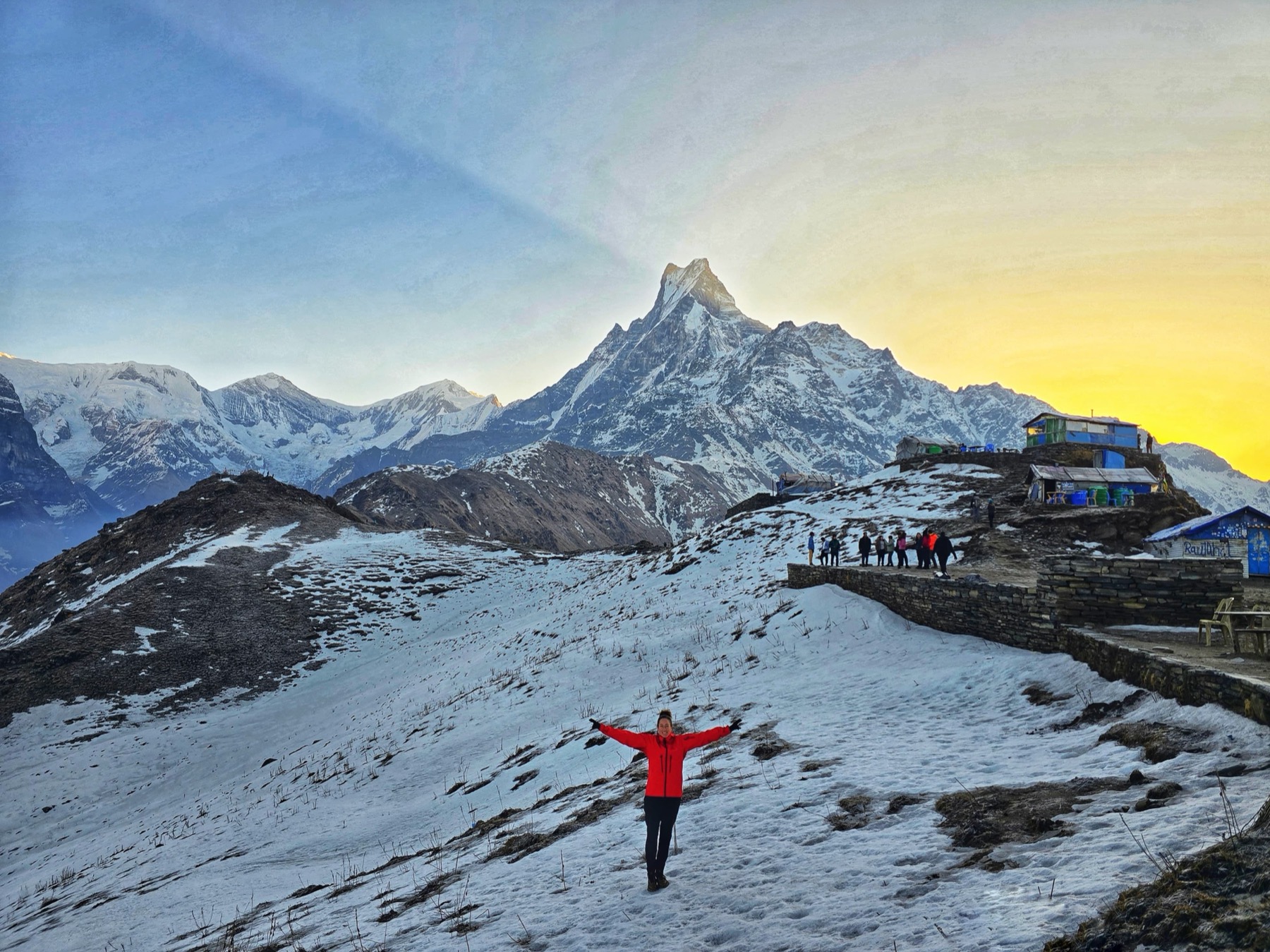
Away before first light with head torches on, up a thinning ridge with the ground dropping away on both sides. The Upper Viewpoint at 4,200 m comes after three hours or so, and Base Camp at 4,500 m is an hour beyond it, with Machhapuchhre near enough to seem touchable. Then back down past High Camp to Low Camp.
- Altitude
- 4,500 m (14,760 ft) at Base Camp+920 m
- On foot
- 16 km, 8–9 hrs
- Night in
- Teahouse, Low Camp
- Meals
- Breakfast, Lunch, Dinner
A long descent on a trail you have not walked, leaving the ridge at Low Camp and dropping through forest and terraced fields to the Gurung village of Siding at 1,700 m. A jeep meets us for the rough two to three hour drive to Pokhara, where there is a hot shower and a proper bed waiting at the end of it.
- Altitude
- 830 m (2,720 ft)−3,670 m
- On foot
- 13 km, 5–6 hrs
- Night in
- Hotel, Pokhara
- Meals
- Breakfast, Lunch, Dinner
Fly or drive to Kathmandu, whichever you chose when you booked. The afternoon is free for Thamel and for buying the things you promised people you would bring back. In the evening we eat together with your guide, which is when the photographs come out and the week gets properly finished off.
- Altitude
- 1,400 m (4,590 ft)+570 m
- On foot
- —
- Night in
- Hotel, Kathmandu
- Meals
- Breakfast, Dinner
We drive you to the airport in good time for your flight. If you have left a spare day or two at this end, Pokhara rewards going back to and Chitwan is a few hours down the road from it. Tell us before you book and we will put either one on the end for you.
- Altitude
- —
- On foot
- —
- Night in
- —
- Meals
- Breakfast
What's included
Included in the price
- Airport transfers & ground transport
- Licensed English-speaking guide
- Accommodation throughout the trip
- All permits & conservation area fees
- Meals as per the itinerary
Not included
- International flights
- Travel & rescue insurance
- Personal trekking gear
- Tips & personal expenses
- Nepal entry visa (on arrival)
What to bring
Pack light, because everything on this ridge is carried by hand
Your porter takes 15 kg shared between two of you, which is generous for a six day trek and more than you should need. There is no flight weight limit to worry about here, so the constraint is the trail rather than an aircraft. Remember that above Low Camp the lodges have no road, no mule and no cable: the gas, the rice and your washing water all came up on somebody's back, which is a decent reason to want less of everything. We hand you a duffel in Pokhara, and the bag and the jacket are ours as well, so none of those three need to come from home.
On your head
- A brimmed hat for the sun and a wool one that comes down over your ears
- Two buffs, or a buff and a neck gaiter
- Sunglasses, category 3. The ridge is bright even under cloud
- Headtorch and spare batteries. The Base Camp morning starts in the dark
- SPF 50 sunscreen, and a lip balm that blocks sun as well
On your body
- Three merino or synthetic base layers, no cotton
- A fleece and one light insulated jacket
- Down jacket for High Camp and the dawn start. We provide one
- Waterproof jacket and trousers that pack small. Afternoon cloud often means rain
- Two pairs of trekking trousers
- Underwear for four days and wash at Pokhara
Hands and feet
- Liner gloves and a warmer pair over them
- Broken-in boots with ankle support. The Siding descent finds every weakness
- Four pairs of wool trekking socks
- Camp shoes for the evenings
- Trekking poles, both of them, and for once this is not optional advice
Bags
- A porter duffel, 15 kg at the outside. Ours, handed over in Pokhara
- Daypack of 25 to 30 litres with a rain cover
- Dry bags or a thick liner. Forest Camp earns its name in every season
Sleeping
- A bag rated to −10°C, which we supply
- Silk or cotton liner, for warmth and for hygiene
- Earplugs. High Camp walls are a single sheet of plywood
Health
- Blister plasters, tape, painkillers and rehydration salts
- Anything you take routinely, in your daypack and not the duffel
- Water purification tablets or a filter, because water is short above Low Camp
- Hand sanitiser and wet wipes for the two days without a shower
- Leeches sting in the monsoon shoulder weeks: take a small bottle of salt if you go in June or September
Papers and money
- Passport valid six months, plus a photocopy
- Two passport photographs for the permits
- Insurance certificate showing helicopter cover to 5,000 m
- Rupees in small denominations, $150 to $250 worth. Pokhara has the last cash machine
Getting to the trailhead
No mountain airstrip, no week-long weather delay, and a road that reaches within an hour of the first step.
Pokhara, and why this trek is easy to get to
Twenty five minutes from Kathmandu into an airport on flat ground at 830 m, with the whole Annapurna wall out of the left window. Delays here are counted in hours, not days, and nothing on this itinerary depends on a mountain airstrip clearing. That is the practical difference between planning an Annapurna trek and planning an Everest one.
The coach is a real choice
Six to eight hours down the Prithvi Highway beside the Trishuli for about twenty five dollars, and it has been longer than that whenever the road is being widened. Some people would rather watch the country go past than skip over it, and since nothing here is time critical it is a fair choice rather than a sacrifice. Say which you want when you book.
An hour of road, then you walk
Kande is 27 km from Pokhara on the Baglung highway, about an hour in a car and a little more in a bus. That is the whole transfer. The trek begins at the roadside, climbing from the first minute, which is the main reason day 3 feels steeper than its four hours suggest.
Coming out through Siding
The exit is a jeep track that reaches the Gurung village of Siding, and the drive back to Pokhara is two to three hours of genuinely rough road. It is not comfortable and it is a long way better than two more days of walking on tired knees. In heavy rain the track can close, in which case we walk on to Lwang and drive from there.
Lodges on the ridge
Smaller and fewer than anywhere on the Poon Hill side, and at the top everything you eat and wash in was carried up somebody's back.
9 nights, and what each one is
| Where | Nights | Type | Room | Bathroom |
|---|---|---|---|---|
| Kathmandu | 2 | Three-star hotel | Twin or double | Private, hot water |
| Pokhara | 2 | Three-star hotel by the lake | Twin or double | Private, hot water |
| Pitam Deurali | 1 | Teahouse, one of two at the junction | Twin | Mostly shared, hot shower for a fee |
| Forest Camp | 1 | Teahouse in a forest clearing | Twin, plywood walls | Shared |
| Low Camp | 2 | Teahouse just above the tree line | Twin | Shared, bucket hot water |
| High Camp | 1 | Teahouse on the ridge, five or six of them in all | Twin, and dormitory beds when it is full | Shared, and no shower worth the name |
- Kathmandu
- Nights
- 2
- Type
- Three-star hotel
- Room
- Twin or double
- Bathroom
- Private, hot water
- Pokhara
- Nights
- 2
- Type
- Three-star hotel by the lake
- Room
- Twin or double
- Bathroom
- Private, hot water
- Pitam Deurali
- Nights
- 1
- Type
- Teahouse, one of two at the junction
- Room
- Twin
- Bathroom
- Mostly shared, hot shower for a fee
- Forest Camp
- Nights
- 1
- Type
- Teahouse in a forest clearing
- Room
- Twin, plywood walls
- Bathroom
- Shared
- Low Camp
- Nights
- 2
- Type
- Teahouse just above the tree line
- Room
- Twin
- Bathroom
- Shared, bucket hot water
- High Camp
- Nights
- 1
- Type
- Teahouse on the ridge, five or six of them in all
- Room
- Twin, and dormitory beds when it is full
- Bathroom
- Shared, and no shower worth the name
Heat, hot water, power and signal
- Heating
- A stove in the dining room at Low Camp and High Camp, lit when the sun goes. Bedrooms are never heated.
- Hot shower
- Plumbed and reliable as far as Deurali, $2 to $4. Above Forest Camp it becomes a bucket of hot water, $2 to $5, and at High Camp it may simply not be on.
- Charging
- $2 to $4 a device. Everything above Low Camp runs on solar, so two cloudy days in a row means no sockets for anybody. Bring a power bank.
- Wifi
- Free or a couple of dollars in the villages, patchy at Forest Camp, and treat anything above Low Camp as a bonus rather than a plan.
- Phone signal
- NTC is the better of the two on this ridge and reaches High Camp on a good day. Ncell is weak above the forest. Buy the SIM in Pokhara.
- Water
- Boiled or filtered by the litre, $1 to $3, and dearer the higher you go for a good reason: above Low Camp it is carried uphill by hand.
- Sleeping bag
- Provided, rated to −10°C, which is enough for High Camp in the walking seasons. Lent for the trek and handed back at the end.
- Bedding
- A mattress, a pillow and a blanket or two. The bag goes on top of them, not instead of them.
What you eat
| Meal | Time | Usually |
|---|---|---|
| Breakfast | 6:30–7:30 | Porridge, eggs any way you like, Tibetan bread, chapati, pancakes, tea or coffee |
| Lunch | 11:30–13:00 | Dal bhat, fried rice, noodles, thukpa, momo, potatoes any way you like |
| Dinner | 18:30–19:30 | Dal bhat, pasta, curry and rice, garlic soup to start |
| Tea | on arrival | Ginger, lemon, masala, milk or plain black. Comes with every stop. |
- Breakfast
- Time
- 6:30–7:30
- Usually
- Porridge, eggs any way you like, Tibetan bread, chapati, pancakes, tea or coffee
- Lunch
- Time
- 11:30–13:00
- Usually
- Dal bhat, fried rice, noodles, thukpa, momo, potatoes any way you like
- Dinner
- Time
- 18:30–19:30
- Usually
- Dal bhat, pasta, curry and rice, garlic soup to start
- Tea
- Time
- on arrival
- Usually
- Ginger, lemon, masala, milk or plain black. Comes with every stop.
If you eat differently
| Diet | On this route |
|---|---|
| Vegetarian | Straightforward everywhere. Dal bhat is vegetarian, it is cooked fresh, and the second helping is free. |
| Vegan | Workable with notice, though butter and curd turn up in more things than the menu admits. Tell us when you book and the guide orders ahead. |
| Gluten free | Rice, dal, potatoes and eggs are fine. Bread, noodles, momo and most soups are not, and a two burner teahouse kitchen cannot separate anything properly. |
| Halal | No certified kitchen on this trail. Vegetarian is the practical answer and nobody will find it odd. |
| Meat | On the menu, and we would skip it above Forest Camp. There is no refrigeration up there and it walked in. |
- Vegetarian
- On this route
- Straightforward everywhere. Dal bhat is vegetarian, it is cooked fresh, and the second helping is free.
- Vegan
- On this route
- Workable with notice, though butter and curd turn up in more things than the menu admits. Tell us when you book and the guide orders ahead.
- Gluten free
- On this route
- Rice, dal, potatoes and eggs are fine. Bread, noodles, momo and most soups are not, and a two burner teahouse kitchen cannot separate anything properly.
- Halal
- On this route
- No certified kitchen on this trail. Vegetarian is the practical answer and nobody will find it odd.
- Meat
- On this route
- On the menu, and we would skip it above Forest Camp. There is no refrigeration up there and it walked in.
What a day is like
A day on the trail
- 6:00Tea brought to the room, and a bowl of warm water if there is any
- 6:30Pack, and leave the duffel by the door for the porter
- 7:00Breakfast, all together, in the only warm room in the building
- 8:00On the trail. The guide walks slower than you would, deliberately
- 11:30Lunch at a lodge on the route, an hour of it
- 13:00One to three hours more, and the cloud usually arrives before you do
- 15:00In, tea, a bed claimed, boots off, sleep if you want it
- 17:00From Low Camp up, the oximeter comes out and the reading goes in the book
- 18:30Dinner, and the guide talks through tomorrow and tomorrow's weather
- 20:30Bed. On the ridge in November, nobody argues with this
How hard it is, and getting ready
Steady walking, one demanding morning.
- Four to six hours a day for five days, and one day of eight to nine on the ridge.
- Steep underfoot in three places: out of Kande, the forest above Deurali, and the whole descent to Siding.
- The highest bed is 3,580 m, low enough that most people feel the altitude only as slowness.
- No rope, no crampons and no pass. The exposure above High Camp is real but the ground is a path.
- Knees decide the last day. The drop from Low Camp to Siding is 1,270 m in one go.
Twelve weeks, and what to do in each of them
Written for somebody who walks a bit and does not train. If you already run or cycle regularly, start at the eight-week block. Nothing here needs a gym.
- 1
Ten weeks out
Build the base
Three sessions a week of 40 minutes, hard enough to breathe and easy enough to talk. Walking, cycling, rowing, swimming, take your pick. If you do only one thing on this list, make it this one.
- 2
Eight weeks out
Find some hills
Swap one session for a hill walk of an hour with 250 m of climbing. Add squats, step-ups and calf raises once a week. On this trek the descending hurts more than the climbing, and that is what those are for.
- 3
Six weeks out
Wear the boots
Every walk from here on happens in the boots that are coming to Nepal, with the pack that is coming too, weighted to 5 kg. More days get spoiled on this trail by blisters than by thin air, and a blister is a problem you can solve at home.
- 4
Four weeks out
Two days running
Four hours on the Saturday, then two more on Sunday morning before the legs have forgiven you. Back to back days are the thing a trek actually consists of, and a single big walk once a month prepares you for none of it.
- 5
Three weeks out
The long one
Five hours with 700 m up and 700 m back down, poles in hand. Get through that able to eat properly and sleep well, and the ridge morning will be a matter of getting up early rather than of fitness.
- 6
Ten days out
Ease off
Cut the distance in half and keep the frequency. Nothing you do now adds fitness and a fair amount of it can injure you. Sleep, and check your kit instead.
Altitude, and what we do about it
You sleep no higher than 3,580 m on this trek, which is why serious altitude illness is uncommon on it. The catch is the shape of the last two days: Low Camp to High Camp is a 600 m gain, and the following morning takes you 920 m higher again in three or four hours. That is a fast climb by any standard, and it is why a headache at High Camp is worth mentioning at dinner rather than at dawn. Coming straight back down the same day is what makes it safe.
Tell your guide if you have any of these
- Headache that stays after water and paracetamol
- No appetite at dinner when you have walked all day
- Nausea, or feeling vaguely drunk on nothing
- Breathless sitting still, not just on the climb
- Broken sleep, waking up gasping
- A cough that is worse at bedtime than it was at lunch
- Stumbling or losing your balance, which means down, now
What actually prevents it
- Let the guide set the pace on day 6. It will feel too slow and that is the point.
- Aim at three litres a day. Thirst is an unreliable guide up here and it will not prompt you often enough.
- Eat dinner at High Camp even if you would rather go to bed. Appetite goes first.
- No alcohol at High Camp and no sleeping tablets anywhere on the ridge.
- Sleep at Low Camp on the way in rather than pushing to High Camp in one day.
- If the headache is there at 5 a.m., stop at the Upper Viewpoint or do not go up at all.
What we do about it, in order
- 1
We measure from Low Camp up
There is an oximeter in the guide's pack, and from 2,970 m onward your reading goes into a notebook every evening alongside your pulse. Two nights of figures turn a vague feeling into something anybody can act on.
- 2
If it is mild, we shorten the day
The ridge morning is easy to cut: turn at the Lower Viewpoint just below Base Camp, or stop at 4,200 m. The view from either is the same mountain at the same distance.
- 3
If it is not, we descend
Descent is the treatment, and on this route it is unusually quick. Low Camp is two hours below High Camp and Forest Camp is two hours below that, which is 1,000 m of relief inside an afternoon.
- 4
If it comes to it, we fly
Helicopters land at High Camp and at Low Camp, and Pokhara is fifteen minutes away by air with a full hospital in it. Expect a bill of $2,500 upwards. That figure is precisely why we check your policy before you leave the lake.
- 5
There is no clinic on the ridge
Unlike the Khumbu, this trail has no aid post. The nearest proper medical care is Pokhara. That is an argument for caution at High Camp rather than a reason to avoid the trek.
Fitness and altitude are unrelated
This is the thing people get wrong most often. Training makes the walking easier and does nothing for how your body handles thin air. Strong young trekkers get altitude sickness and unfit older ones frequently do not. Go up slowly, and say something the first time your head hurts.
Month by month
Two months we do not run at all, and two more we run with a warning about what the ridge does under snow.
| Month | Day on the trail | Night on the trail | Night at High Camp | What it is like | |
|---|---|---|---|---|---|
| January | +7°C | -4°C | -12°C | Hard | Bitter and extremely clear. Snow on the upper ridge and some High Camp lodges shut. |
| February | +9°C | -3°C | -10°C | Hard | Cold and quiet, with old snow above Badal Danda well into the month. |
| March | +13°C | 0°C | -6°C | Best | The season opens and the rhododendron below Forest Camp starts to go. Excellent. |
| April | +16°C | +4°C | -2°C | Best | Warm walking, flowering forest, and the ridge clear most mornings before the cloud. |
| May | +18°C | +7°C | +1°C | Good | Pleasant and hazy. Cloud builds earlier each week and the afternoon views go first. |
| June | +19°C | +10°C | +4°C | Hard | Monsoon. Leeches in the forest section, rain most afternoons, and Machhapuchhre hidden. |
| July | +18°C | +11°C | +5°C | We do not run it | We do not run it. You would walk six days in cloud and see the mountain once, if lucky. |
| August | +18°C | +11°C | +5°C | We do not run it | As July, and the Siding jeep track washes out regularly. |
| September | +16°C | +9°C | +3°C | Good | Clearing through the month. The last ten days are green, washed and almost empty. |
| October | +14°C | +5°C | -2°C | Best | The most reliable month and much the busiest. High Camp beds go by early afternoon. |
| November | +11°C | +1°C | -7°C | Best | Cold after dark, the sharpest visibility of any month, and fewer people on the ridge each week. |
| December | +8°C | -2°C | -10°C | Hard | Sharp, bright and nearly empty. Fine with the right kit, and the ridge ices up after any snow. |
- January
- Day on the trail
- +7°C
- Night on the trail
- -4°C
- Night at High Camp
- -12°C
- What it is like
- Bitter and extremely clear. Snow on the upper ridge and some High Camp lodges shut.
Hard - February
- Day on the trail
- +9°C
- Night on the trail
- -3°C
- Night at High Camp
- -10°C
- What it is like
- Cold and quiet, with old snow above Badal Danda well into the month.
Hard - March
- Day on the trail
- +13°C
- Night on the trail
- 0°C
- Night at High Camp
- -6°C
- What it is like
- The season opens and the rhododendron below Forest Camp starts to go. Excellent.
Best - April
- Day on the trail
- +16°C
- Night on the trail
- +4°C
- Night at High Camp
- -2°C
- What it is like
- Warm walking, flowering forest, and the ridge clear most mornings before the cloud.
Best - May
- Day on the trail
- +18°C
- Night on the trail
- +7°C
- Night at High Camp
- +1°C
- What it is like
- Pleasant and hazy. Cloud builds earlier each week and the afternoon views go first.
Good - June
- Day on the trail
- +19°C
- Night on the trail
- +10°C
- Night at High Camp
- +4°C
- What it is like
- Monsoon. Leeches in the forest section, rain most afternoons, and Machhapuchhre hidden.
Hard - July
- Day on the trail
- +18°C
- Night on the trail
- +11°C
- Night at High Camp
- +5°C
- What it is like
- We do not run it. You would walk six days in cloud and see the mountain once, if lucky.
We do not run it - August
- Day on the trail
- +18°C
- Night on the trail
- +11°C
- Night at High Camp
- +5°C
- What it is like
- As July, and the Siding jeep track washes out regularly.
We do not run it - September
- Day on the trail
- +16°C
- Night on the trail
- +9°C
- Night at High Camp
- +3°C
- What it is like
- Clearing through the month. The last ten days are green, washed and almost empty.
Good - October
- Day on the trail
- +14°C
- Night on the trail
- +5°C
- Night at High Camp
- -2°C
- What it is like
- The most reliable month and much the busiest. High Camp beds go by early afternoon.
Best - November
- Day on the trail
- +11°C
- Night on the trail
- +1°C
- Night at High Camp
- -7°C
- What it is like
- Cold after dark, the sharpest visibility of any month, and fewer people on the ridge each week.
Best - December
- Day on the trail
- +8°C
- Night on the trail
- -2°C
- Night at High Camp
- -10°C
- What it is like
- Sharp, bright and nearly empty. Fine with the right kit, and the ridge ices up after any snow.
Hard
Built from Pokhara station averages adjusted for height, and checked against what our guides record on the ridge. Any week runs several degrees either side, and the wind above High Camp does more to how cold it feels than the thermometer.
Who walks with you
Who walks with you
Your guide holds a government licence and current wilderness first aid training, and there is one porter between every two trekkers. Past ten trekkers a second guide comes along so that the front and the back of the group are both covered. Our guides live in this district and several of them grew up in the villages below Low Camp.
What the porter carries
Fifteen kilos, which is two duffels. That is well under the 25 kg the trekking association allows and deliberately so, because the climb to High Camp is steep and the descent to Siding is long. If your bag is over the limit we split it rather than stack it. Your water, camera and jacket stay with you in a daypack.
Pay, food and insurance
Wages, insurance, meals and beds for the whole crew sit inside the price on this page. Nobody will raise a collection on the trail. The cover each guide and porter carries for altitude illness and for a helicopter matches what we require from you, with no lower tier for the people doing the carrying. The only way to guarantee that is to build it into the price rather than trust that somebody else has.
Tipping
Usual, not compulsory, and never a stand-in for a wage. For a trek this length, $90 to $140 per trekker for the whole team is about right, given on the last evening in one go rather than in pieces. Nobody will ask you, and asking your guide what is appropriate will only embarrass them.
Walking it responsibly
The water on this ridge is somebody's back
Above Low Camp there is no spring at the lodges and no pipe. Every litre you drink, and every bucket you wash in, was carried uphill by a person. Buy boiled or filtered water by the litre, carry a filter or tablets as your backup, and think twice about a hot bucket at High Camp when a flannel would do.
Nothing stays up there
We carry out everything we carry in apart from food. This trail is only a decade old and it is still in reasonable condition, which is a rare thing in Nepal and worth a little effort to keep. Wrappers, batteries and the rest come back down in our bags.
Where your money ends up
The lodges on this ridge are family businesses, most of them opened since 2012 by households from Siding, Lwang and Ghalel. The permit fee funds the conservation area, which a national trust runs rather than a ministry. Almost everything you spend here stays within a day's drive of where you spent it.
How to be on the trail
Ask before you photograph anyone, and mean it. Step to the uphill side for a mule train and let it go by. Machhapuchhre has never been climbed and is not permitted to be, because it is sacred to the people whose fields you walk through, and that is worth remembering when you are standing underneath it.
Booking and paying
How to start
Send us a message or a WhatsApp with a rough month in it. You will get an answer from somebody who has been up that ridge, usually the same day, and nothing is owed until you decide to hold dates.
The deposit
Thirty per cent holds your dates and the balance is due when you reach Kathmandu or Pokhara, by card or in cash. Send a passport copy, proof of insurance and anything medical or dietary we should know about while you are at it.
Paying
Bank transfer or a secure card link. Card payments carry the bank's charge of roughly 4 per cent and we show it to you before you pay, not on the receipt afterwards. The balance can be settled in dollars, pounds, euros or rupees.
If you cancel
More than 30 days ahead, your deposit moves to any other date or any other trek we run, with no expiry. Inside 30 days we keep it, because the permits, the crew and the lodges are committed by then. If we cancel for anything other than weather, you get all of it back.
Private or joining a group
From five people the two cost exactly the same. Book privately and the dates, the pace and the party are yours, down to a single trekker; book onto a departure and you take the dates in the table above, capped at ten. Once people spot that the price does not move, most of them go private.
Booking late
A week is plenty outside October, because there is no mountain flight to squeeze onto. In October the constraint is beds at High Camp rather than anything else, and for that month we would want three or four weeks' notice.
Things you can add
Priced per person, arranged before you travel, and none of them included in the price above.
- 1 morning
Paragliding over Pokhara
$95Half an hour off Sarangkot with the Annapurnas on the far side of the valley. Day 9 is free if you fly to Kathmandu in the afternoon.
- +4 days
Poon Hill first
from $340Ghorepani and the 3,210 m sunrise before you start the ridge. It doubles as acclimatisation and it makes High Camp noticeably easier.
- +2 days
Two more nights in Pokhara
$110Lakeside, at the end, with a boat and nothing to climb. Almost nobody regrets the extra nights and a fair number regret not booking them.
- +1 day
Walk out through Landruk
no changeLeave the ridge at Low Camp towards the Modi Khola instead of Siding, for one more village night and a gentler descent. Ask if your knees are the doubtful part.
- +3 days
Chitwan jungle safari
from $390Rhino, gharial and heat, a few hours by road from Pokhara. It slots in between the trek and your flight home without doubling back.
Single room
$95Applies to the four hotel nights in Kathmandu and Pokhara only. Ridge lodges are twin share throughout, and a full High Camp in October may put you in a dormitory whatever we ask for.
Other ways to walk this ridge
4 versions of this journey. They use the same guides and the same lodges; what changes is the length, the comfort and how much of it you walk.
- Mardi Himal TrekYou are hereThe one on this page. Kathmandu to Kathmandu with two nights in Pokhara and a full day on the ridge.10 days$897
- Mardi Himal from PokharaStart and finish at the lake, skip Kathmandu, same ridge and the same dawn climb. For people already in Nepal.6 days$597
- Mardi Himal with Poon HillGhorepani and the sunrise first, then the ridge. Better acclimatised, and the two best short viewpoints in one trip.13 days$1,197
- Annapurna Base CampUp the gorge into the sanctuary instead of along the ridge. Longer, busier, and a completely different kind of day.14 days$1,287
Photos
A look at the trail, the villages and the mountains.
Reviews
4.8 12 reviews
The trip of a lifetime
Everything was handled for us from the moment we landed. Our guide read the group perfectly, slowed the pace when we needed it, and knew every village along the way. I never once worried about logistics.
Sarah M. AustraliaOctober 2025
Felt looked after the whole way
We travelled as a couple and the small group made all the difference. Comfortable lodges, honest advice about the altitude, and a team who clearly loved the mountains. Booking on our own dates was easy.
James & Kate United KingdomMay 2025
Well organised and genuinely local
You can tell this is run by people from here, not a call centre abroad. The itinerary had proper rest days built in, the food was better than I expected, and the whole thing ran to time.
Daniel R. CanadaMarch 2025
Common questions
21 of them, and they are the ones people actually send us. If yours is not here, ask and we will answer it and add it.
None at all. There is no rope, no crampons and no glacier anywhere on this route. The upper ridge is a footpath that happens to have a lot of air on either side of it, and if that idea bothers you, the Upper Viewpoint at 4,200 m is a perfectly good place to stop.
Fit enough for four to six hours of walking on consecutive days, plus one morning of eight to nine hours. If you can manage a five hour hill walk at home and then get up and do two hours the next day, you are ready for this one.
It is one of the best, and better than most of the routes marketed that way. It is short, the highest bed is only 3,580 m, and you stand under a 6,993 m mountain at close range. What it asks for is six days of steady walking rather than any particular skill.
Most people get to the Upper Viewpoint at 4,200 m. Rather fewer go the last hour to Base Camp at 4,500 m, and the reasons are almost always weather or the clock rather than fitness. On a clear morning the two views are the same mountains at slightly different distances.
No upper one. We take children from ten with a parent, which is younger than we would accept on an Everest trek, because the altitude here is modest and you can be off the ridge in an afternoon. Walking history matters far more than age.
Narrow in places, with the ground falling away on both sides, and it is a path throughout. In clear weather most people find it exhilarating. In cloud or on fresh snow it is a different proposition, and that is the morning your guide may turn the group round.
It is uncommon here because you sleep no higher than 3,580 m, but the climb from Low Camp to Base Camp is fast and mild symptoms do turn up at High Camp. We take your oxygen saturation every evening from Low Camp onward. Descent is quick on this route, which is the main thing in its favour.
Between −2°C and −7°C at night in the trekking seasons, and down near −12°C in January. Days on the trail sit between 11°C and 18°C and feel warm in the sun. No bedroom on this trail is heated, at any altitude, and that is the gap the sleeping bag exists to fill.
A policy good for trekking to 5,000 m that pays for a helicopter and for getting you home. Show us the certificate before we drive out of Pokhara. A rescue from this ridge costs $2,500 upwards and no helicopter takes off without a guarantee that somebody is paying.
Small, plain and fewer than you expect. Plywood rooms with twin beds, a dining room with one stove, shared toilets, and at High Camp five or six lodges in total. It is a rung simpler than the Poon Hill side, which is the price of the trail being quiet.
As far as Deurali, yes, and properly plumbed. Above Forest Camp it becomes a bucket of hot water for a few dollars, and at High Camp there may be none at all, because the water came up the hill on somebody's back. Two days of wet wipes and nobody minds.
NTC reaches High Camp on a good day and Ncell struggles above the forest. Wifi is free or a couple of dollars in the villages, patchy at Forest Camp and unreliable above it. Buy the SIM in Pokhara, since you cannot register one on the trail.
Yes, for $2 to $4 a device, and everything above Low Camp runs on solar panels. Two overcast days in a row and there is nothing to give anybody. Carry a power bank of at least 10,000 mAh and sleep with it rather than leaving it out in the cold.
Far less than Poon Hill or the sanctuary, and it is busier every year. In October the ridge is genuinely busy and High Camp fills by mid afternoon, which is why we walk early that month. In late November or March you can have the forest largely to yourself.
Your duffel goes to a porter shared with one other trekker, 15 kg between you. You carry a daypack of 5 to 7 kg with water, a warm layer, waterproofs and the day's snacks. There is no flight allowance to worry about on this trek.
An ACAP permit at NPR 3,000, about $22, from the National Trust for Nature Conservation, and a TIMS card at NPR 2,000, about $15, through a registered agency. Both are inside your trek price. A licensed guide has been compulsory in this conservation area since April 2023.
Most nationalities buy it at Kathmandu airport on landing: $30 buys 15 days and $50 buys 30, cash only. Complete the online form in the fortnight before you fly and the queue gets shorter. Take a photograph, and make sure your passport has six months to run.
$150 to $250 changed into rupees, in small notes. That covers drinks, charging, hot water, wifi and tips for six days. The last ATM is in Pokhara and no lodge on the ridge takes a card or has any way to give you change for a large note.
Fly 25 minutes from Kathmandu to Pokhara, or take the coach down the Prithvi Highway in six to eight hours. From Pokhara it is 27 km and about an hour by road to Kande, where you start walking. No mountain airstrip is involved at any point.
For October, four to six weeks ahead, because High Camp beds are the bottleneck rather than flights. For every other month, ten days is comfortable and we have put people on this ridge with three days' notice.
Yes, and it is easy on a trek this short. Start from Pokhara and drop Kathmandu, add a night at Badal Danda so the Base Camp day is shorter, walk out through Landruk instead of Siding, or put Poon Hill on the front. From five people your own dates cost the same as a group departure.
You may also like
from$3,187Fly out, not down
Everest Base Camp Luxury Trek, with Helicopter Return - 12 days
from$1,787The quiet side of Everest
Gokyo Lakes and Gokyo Ri Trek - 15 days
Not found what you were looking for?
Search every word on this page, or ask somebody who has walked the route.
10 days
$965 per person